
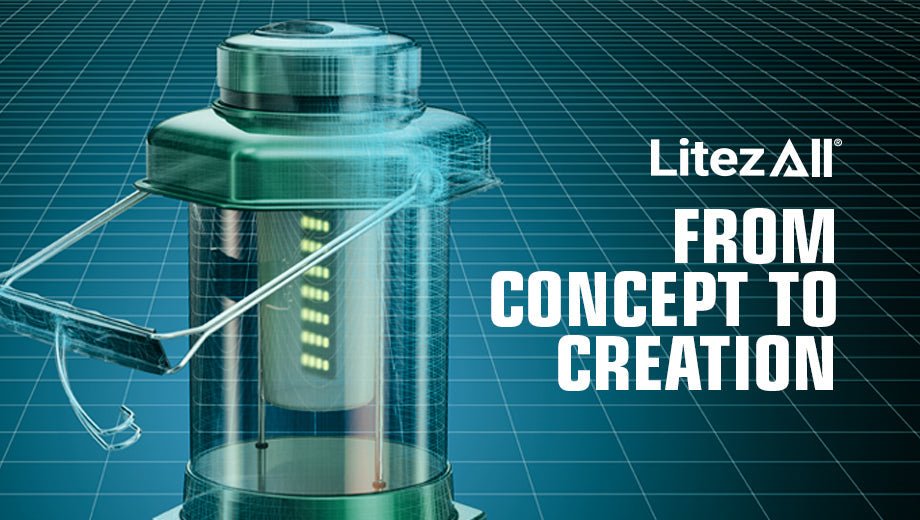
A flashlight looks simple. You press a button, and it turns on.
But if you’ve ever had a light die halfway through a job, flicker when it gets hot, or crack after one drop onto concrete, you already know something most people don’t:
Design matters.
At LitezAll, the flashlight design process isn’t about chasing the biggest brightness number we can print on a package. It’s about building lighting that performs in the real world—on job sites, in garages, during power outages, and in emergency kits.
Here’s how we take a flashlight from concept to retail shelf—and what actually goes into making a reliable one.
Identifying the Market Need
Most people assume flashlight design starts with brightness—how many lumens it can claim.
(Lumens measure total light output. More lumens usually means more brightness—but that doesn’t automatically mean better performance.)
In reality, the process starts earlier.
Before we ever talk about LEDs or housing design, we ask:
-
Who is this light for?
-
What job is it solving?
-
What price point does it need to live at?
-
What’s missing on the retail shelf today?
A homeowner preparing for storm season has different needs than a mechanic working under a vehicle. A contractor on a job site needs something different than someone building an emergency kit.
We analyze:
-
Expected lumen ranges for the category
-
Preferred battery types at each price tier
-
Gaps in beam performance or mounting options
-
Packaging formats already on the shelf
This early stage of portable lighting development defines the product clearly before engineering begins. If you skip this step, you risk building something that looks fine—but doesn’t truly serve the customer.

Designing for Real-World Use
Flashlights don’t live in perfect conditions.
They get dropped. They sit in hot trucks. They’re used with gloves. They get tossed into toolboxes. They’re turned on and off constantly.
So we design for that.
Ergonomics That Actually Matter
If you can’t find the switch quickly, it’s a problem.
If the grip is slick when your hands are dirty, it’s a problem.
We design around:
-
One-handed operation
-
Glove-friendly switches
-
Balanced weight
-
Textured grips that hold up over time
These details don’t sound exciting—but they’re what make a light feel dependable.
Understanding Beam Pattern (Spot vs. Flood)
Brightness alone doesn’t determine usefulness. Beam pattern matters just as much.
A flashlight’s beam pattern is the shape of the light it produces:
-
Spot beam: Narrow and designed for distance
-
Flood beam: Wide and better for close-up tasks
You can have a high-lumen light with a poor beam shape that’s frustrating to use. That’s why we test beam performance in realistic conditions—garages, under hoods, crawl spaces, and dark rooms.
Durability and IP Ratings
You may have seen something called an IP rating on packaging.
An IP rating indicates how well a product is sealed against dust and water. Higher protection levels are critical in job sites, garages, and outdoor conditions.
We evaluate:
-
Impact resistance
-
Housing strength
-
Lens protection
-
Sealing strategy based on intended use
Not every flashlight needs to be fully waterproof—but it should be built for its environment.
Choosing the Right Battery System
Battery choice changes how a flashlight fits into someone’s life.
-
Rechargeable lights are ideal for frequent use
-
Alkaline-powered lights are often preferred for emergency storage
In flashlight product development, matching the power source to the use case is critical.

Engineering & Feature Selection
Once the job is defined, engineering begins.
A flashlight isn’t just an LED in a tube. It’s a complete system:
-
Emitter
-
Driver electronics
-
Optics
-
Housing
-
Seals
-
Battery
-
Thermal management
Each component affects the others.
Lumens vs. Runtime
Lumens measure brightness.
Runtime measures how long the light stays usable before dimming significantly.
A common mistake in how flashlights are made is pushing brightness too hard without balancing runtime or heat.
If a light generates too much heat:
-
It may dim quickly
-
It may drain the battery rapidly
-
It may shorten component lifespan
We engineer for usable brightness—the kind that stays consistent through the task.
COB vs. Traditional LED
You may also see “COB” mentioned.
COB (Chip-on-Board) LEDs create a wide, even wall of light and are common in work lights.
Traditional LEDs, often paired with reflectors, create tighter beams that throw farther.
In work light manufacturing, selecting the correct emitter type is driven by purpose—not trends.
Structural Integrity
A light can look rugged and still fail internally.
We focus on:
-
Housing thickness
-
Internal reinforcement
-
Lens durability
-
Mounting stress points
These are details you won’t see on a spec sheet—but they determine longevity.
Features That Serve a Purpose
We evaluate features carefully:
-
Magnets strong enough to hold position
-
Hooks that don’t flex under load
-
Protected charging ports
-
Mounting systems that simplify hands-free work
Every feature must justify its place.

Testing & Quality Control
Testing is where design becomes proof.
Drop Testing
We simulate real-world drops:
-
From workbenches
-
From vehicles
-
Onto concrete surfaces
Runtime and Battery Validation
We measure:
-
Output stability over time
-
Battery discharge performance
-
Recharge consistency
Thermal Management
Thermal management refers to how a flashlight controls heat.
Brighter lights produce more heat. Without proper design, that heat reduces performance and longevity.
We evaluate housing temperatures and sustained operation to ensure stability.
Compliance Standards
Retail-ready products must meet labeling and safety requirements.
Designing for retail includes compliance from the beginning—not as an afterthought.
This discipline separates structured portable lighting development from generic imports.

Packaging & Retail Strategy
A flashlight can perform well and still fail if the packaging doesn’t communicate clearly.
Packaging must:
-
Protect the product
-
Clearly display lumens and runtime
-
Fit peg hooks or shelves correctly
-
Meet barcode and retail compliance standards
-
Support PDQ or seasonal display formats
Packaging isn’t decoration. It’s part of the flashlight design process.

From Warehouse to Store Shelf
Once production begins, execution matters.
We plan for:
-
Carton durability
-
Container efficiency
-
Pallet configuration
-
Damage prevention during shipping
Retail partners need consistency. The product must arrive in the right packaging, with stable quality, ready for shelf placement.
Designing with logistics in mind is part of responsible product development.

Conclusion
A flashlight may look simple.
But designing one that performs reliably—on a job site, in a garage, or during a power outage—requires deliberate engineering, testing, packaging strategy, and distribution planning.
That’s what the LitezAll flashlight design process is built around.
If you’re looking for dependable lighting designed for real-world use, explore the LitezAll lineup and see how thoughtful design translates into reliable performance.
Explore LitezAll flashlights and work lights built for real homes, real work, and real emergencies.
FAQ
What is the flashlight design process?
The flashlight design process includes identifying a market need, engineering the product for real-world use, selecting features, testing durability and runtime, designing retail packaging, and planning distribution.
How are modern flashlights manufactured?
Modern flashlights are manufactured through component sourcing, housing production, LED integration, performance testing, packaging development, and retail distribution logistics.
What makes a high-quality work light?
A high-quality work light delivers consistent brightness, stable runtime, durable construction, proper heat management, and practical features designed for hands-free work.